Run the whole file.
Drafted, signed, paid, and filed.
One place for everything a matter holds.
Rather see it first?
A matter is more than its documents.
It is the parties and the facts. The deadlines. The agreements and the dates they turn on. The correspondence, the signatures, and everything somebody has to find again three years from now.
Reede keeps all of it in one file — and that is what makes the rest of the platform work. Reminders know what is actually due, because the dates live on the matter. The next draft comes out right, because it is built from the file's own data. The assistant can do real work, because it can see the whole file and not just a folder of documents.
Everything the file needs.
Reede is built around core capabilities that apply to every legal workflow your team runs. The matter type changes; the way Reede works doesn't.
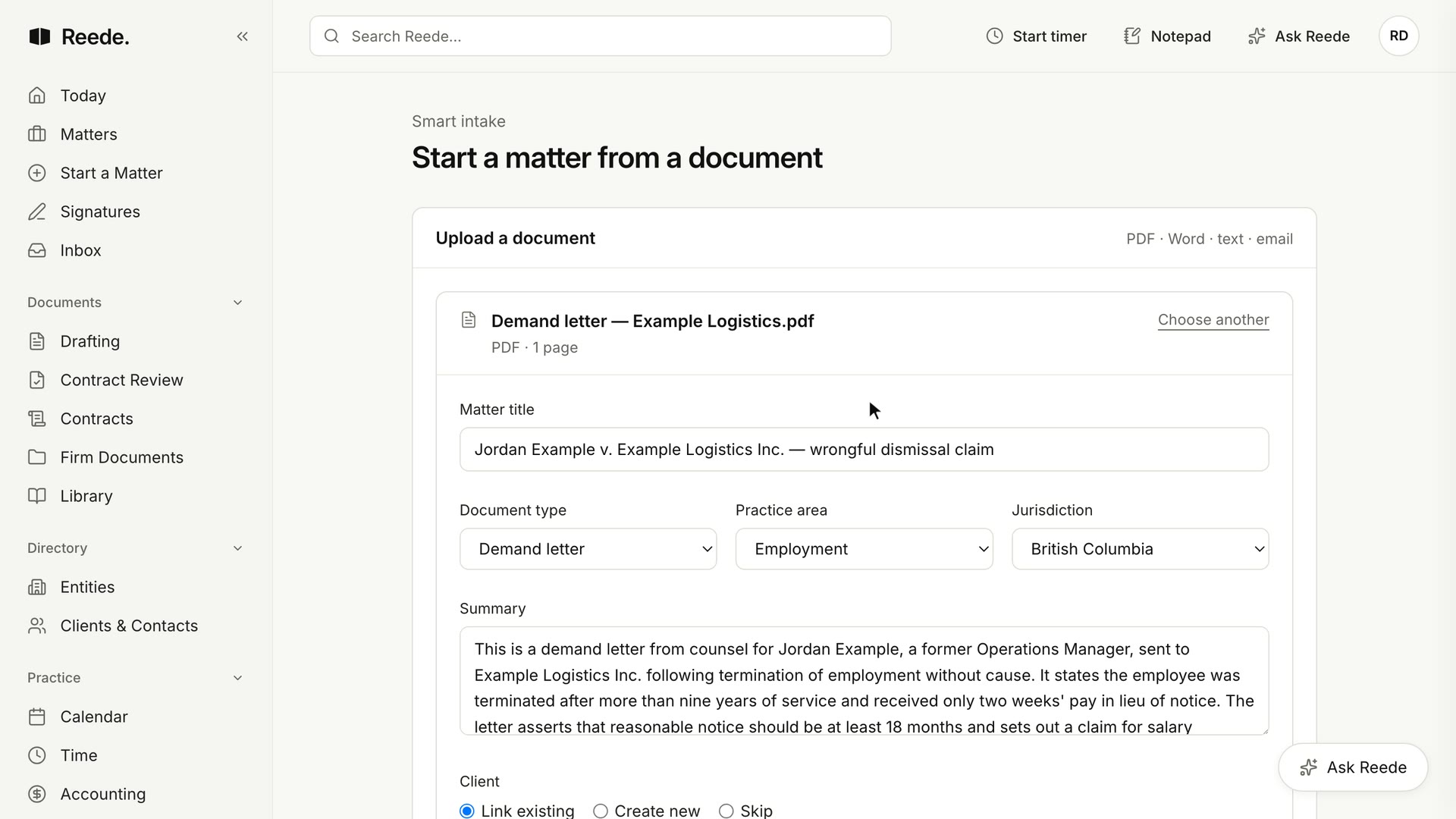
Drop a file, pull the facts.
Any document, any area of law — an intake email, a contract, a court form, a corporate record, a set of instructions. Reede reads it and pulls the structured data out: names, dates, amounts, addresses, parties. You confirm rather than retype.
Drafts built from the file.
Agreements, letters, forms, resolutions, registers — drafted from the data already on the matter, marked DRAFT for counsel review, ready to sign or print.
Signing, built in.
Send for signature from the file. Your client signs in the browser, and the executed copy comes back onto the matter and is filed where it belongs. Signing is part of Reede, not a separate service to connect.
The file watches the calendar.
Filings that come due, contract renewals and notice windows, closing dates, signatures still outstanding, invoices still unpaid. Reede tracks what is due across every open file and raises it with you before it is late.
Every agreement on a register.
A register for the agreements a file turns on — parties, term, renewal and termination windows, with the documents attached. Drop a contract in and Reede reads the terms out of it for you.
Ask Reede, and it can act.
Draft a document, tidy a document set, chase a signature, or ask what is outstanding on a file. It works from the file's real data — and you set how far it goes on its own, from suggesting to drafting to doing.
One subscription, not five.
A file usually crosses several systems on its way to closing, and somebody spends real time keeping those systems agreeing with each other. In Reede they are one product working from one set of facts — nothing to reconcile, nothing to re-key, one bill.
Built to do the work — and guide the workflow.
Jurisdiction-specific by design
Built around real statute and registry practice, not generic templates. Every form, workflow, and default reflects how matters actually run in the jurisdiction you're working in — and Quebec is drafted as civil law under the Civil Code of Québec, not a common-law agreement with the names swapped.
Guided, not just a form
Each workflow walks you through what to capture, in what order, with the right defaults. The Reede intake assistant extracts what it can from the client's instruction letter so you start filled in, not blank.
AI drafts, you approve
Documents are drafted from your file — an agreement, a letter, a closing package, a court or registry form. Every output is marked DRAFT for counsel review. Reede assists; it does not give legal advice.
Manual entry, always available
Every workflow can be filled in by hand. The AI paths are accelerators you take or leave — never a requirement, and never the only way through a file. If you would rather type it yourself, nothing stands in the way.
Private by default
Encrypted in transit and at rest, access-logged, and never used to train AI. See the Security page for where each provider processes your data.
Tell. Drop. Done.
Tell or drop.
Tell Reede what you're working on, or drop in a document — an intake email, a contract, a court form, a corporate record, or a set of instructions. No special format required.
Reede reads, extracts, opens the file.
Reede reads what you gave it, pulls the key data — names, dates, amounts, addresses — and opens the matter that fits: a guided workflow where there is one, and a working file built from your own description where there isn't.
Updates handled.
Status emails to your client, deadline reminders, signing links — sent automatically at every milestone. You stay in control; the busywork doesn't.
Every legal role. Every legal workflow.
- Paralegals
- Lawyers
- Notaries
- Law clerks
- Legal assistants
- Conveyancers
- In-house counsel
Start with your next file.
One practice platform for the work that moves a file. See the plans and find the one that fits your firm.
See plans